Copenhagen

September 22, 2010

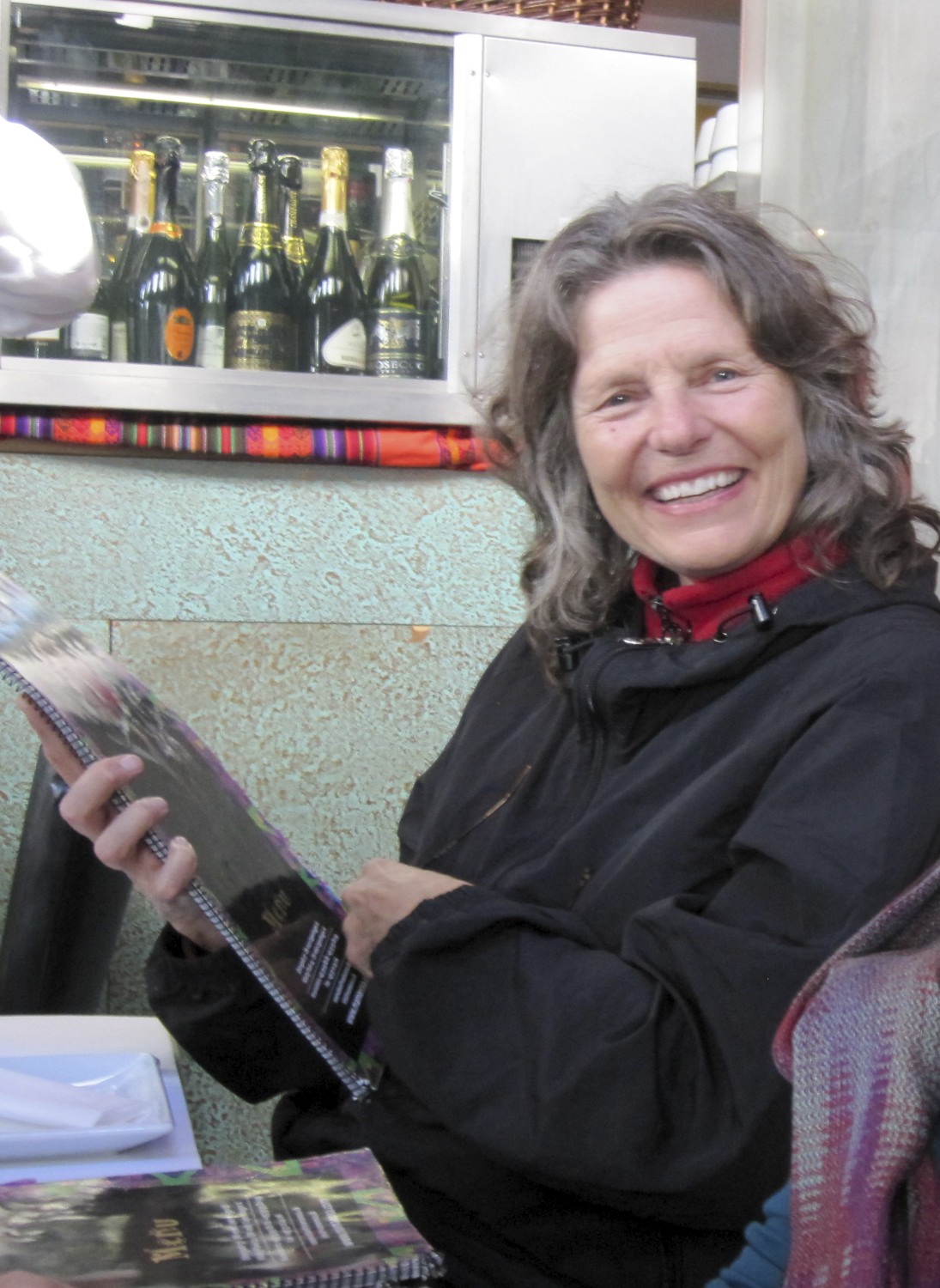
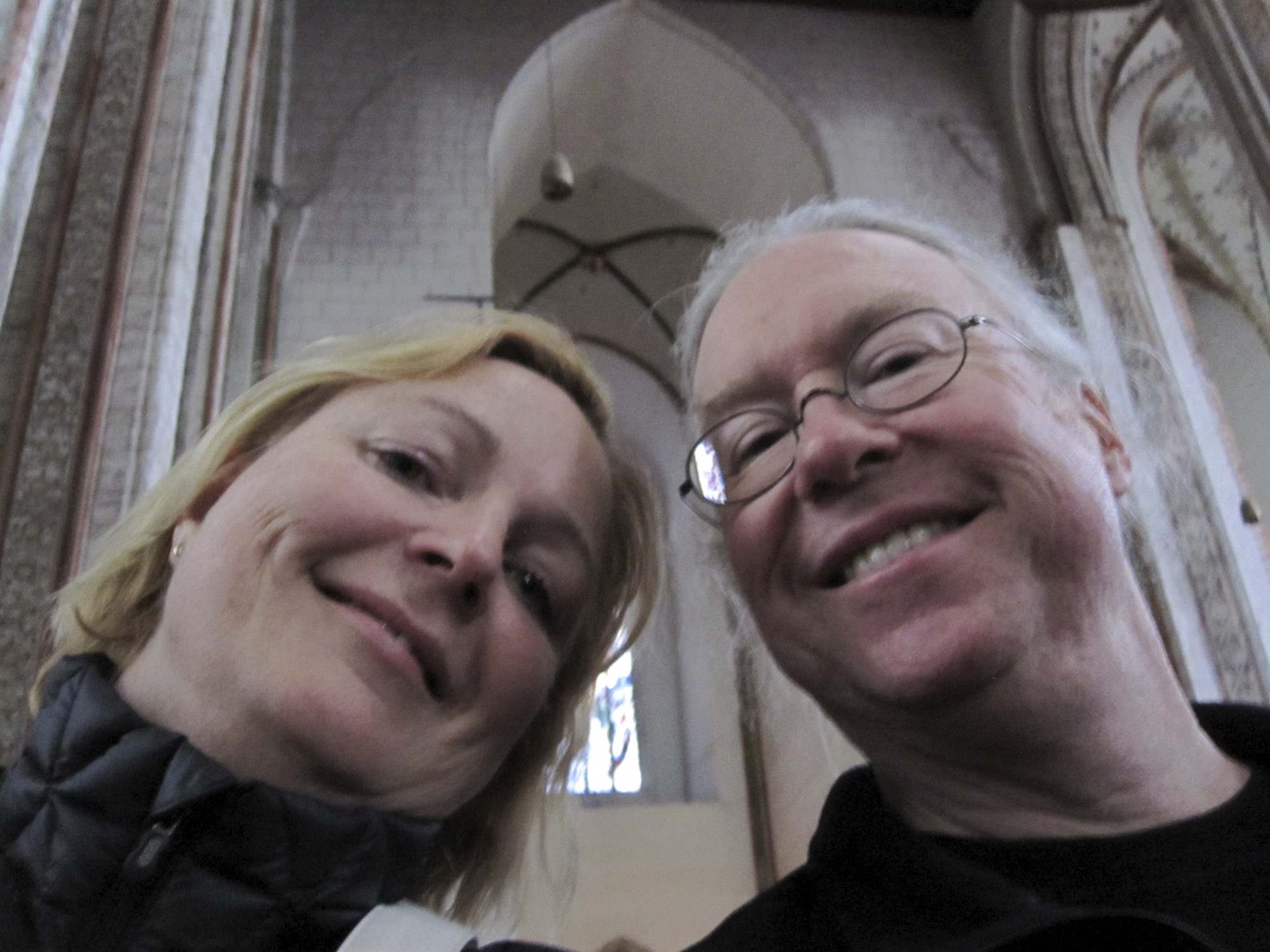
Barnaby and I got off the ship yesterday morning in Copenhagen and are spending a couple of days in this wonderful town. We are so happy we did. Not only are we here at the same time as Dave and Robin (who we ran into yesterday while walking through town) and Barn is going to play with them tomorrow night, but it’s a beautiful city and I’ve never been here before. We’re also having glorious, sunny weather.

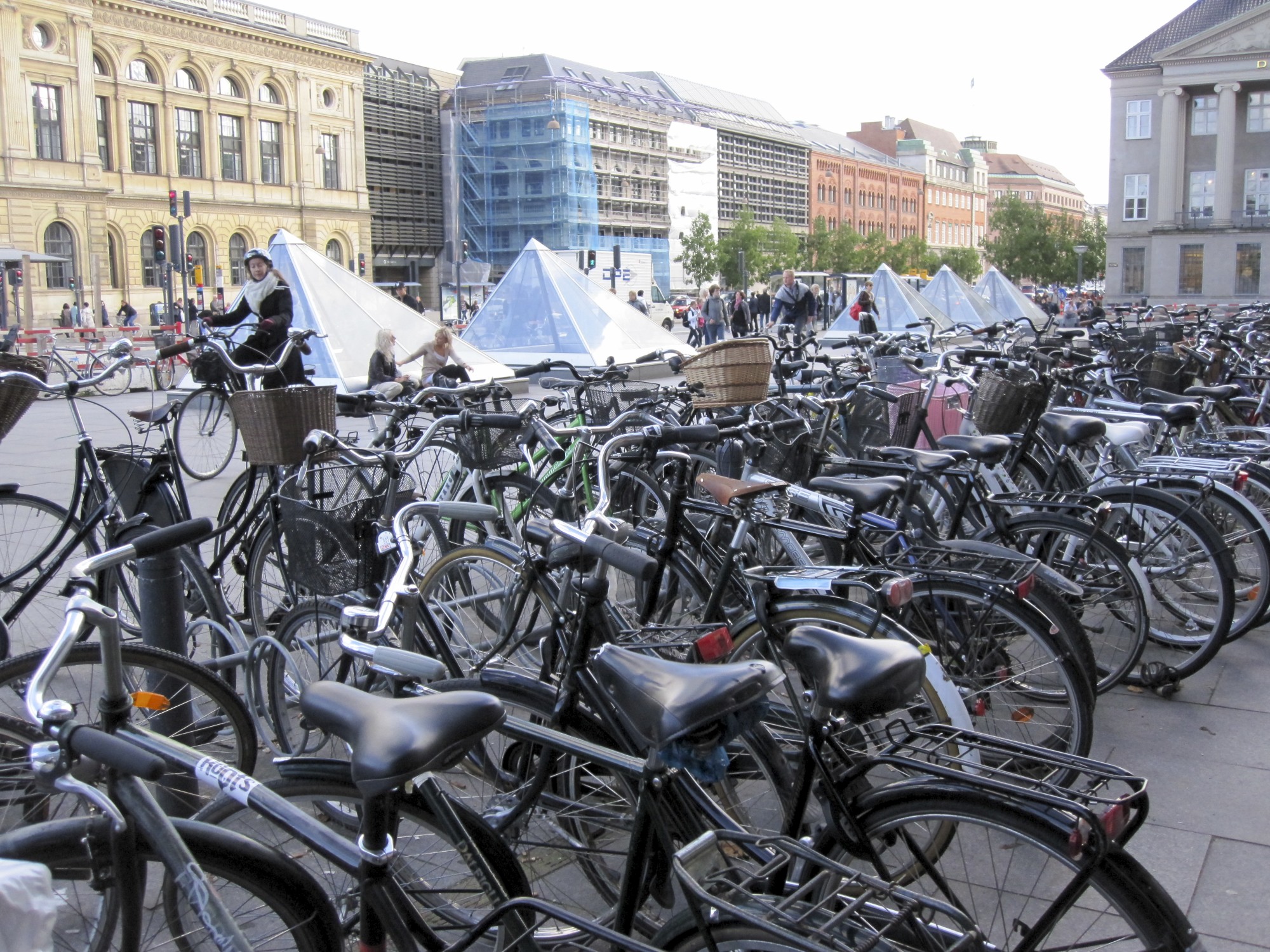
This is a city that gets around on bikes!

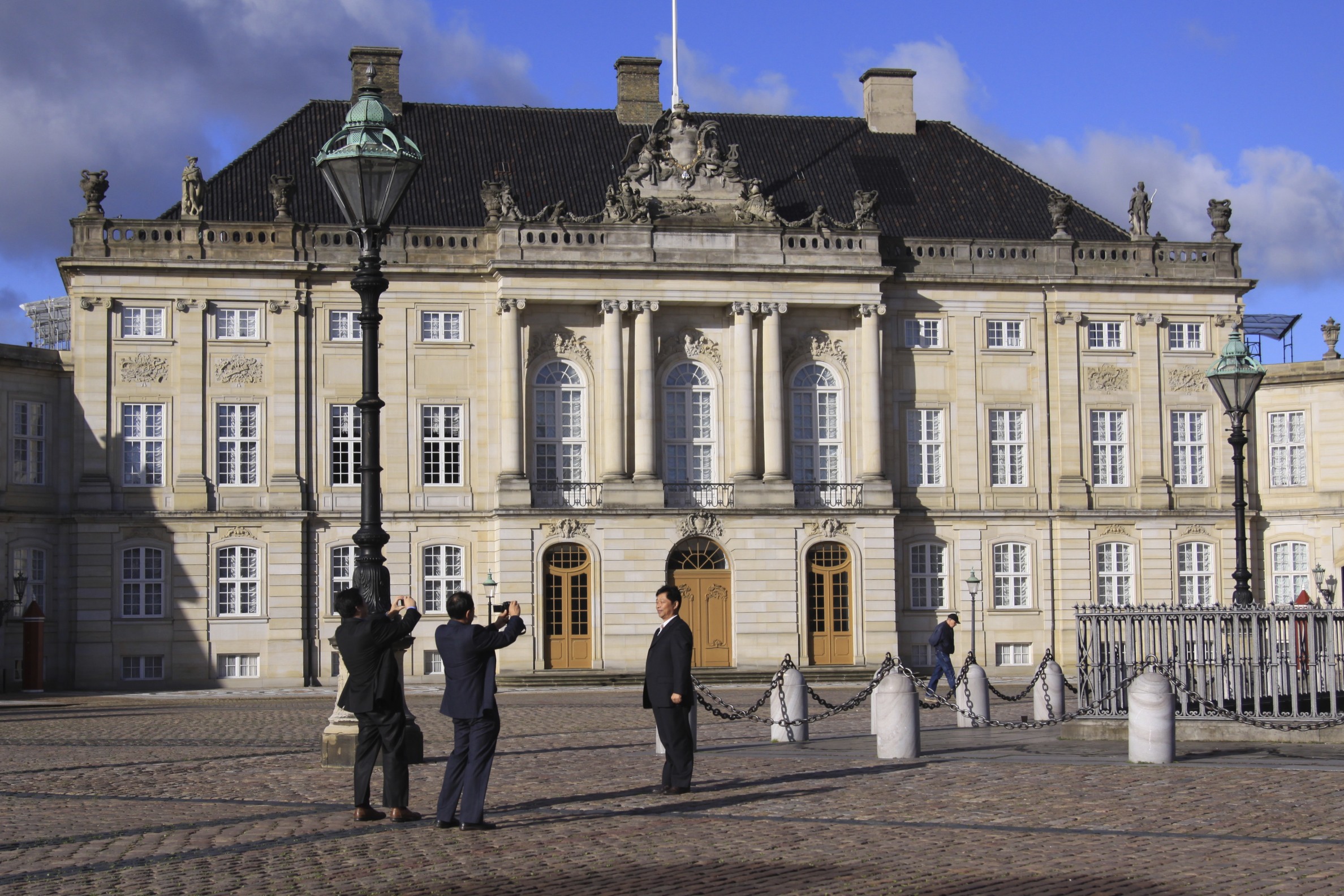
We aren't the only tourists.

I thought I’d just post photos for now. Too tired to write — still getting up early and we are on the go all day. We’re having a wonderful time.


Leaving Bornholm, Denmark on our way to Germany

Last night we traveled about 165 nautical miles from Gdansk, Poland across a very windy Baltic Sea to Bornholm, Denmark. I don’t know how Barnaby manages to sleep through all the rolling and pitching of this ship. I thought I might go sailing out of the bed several times, he slept like a baby.

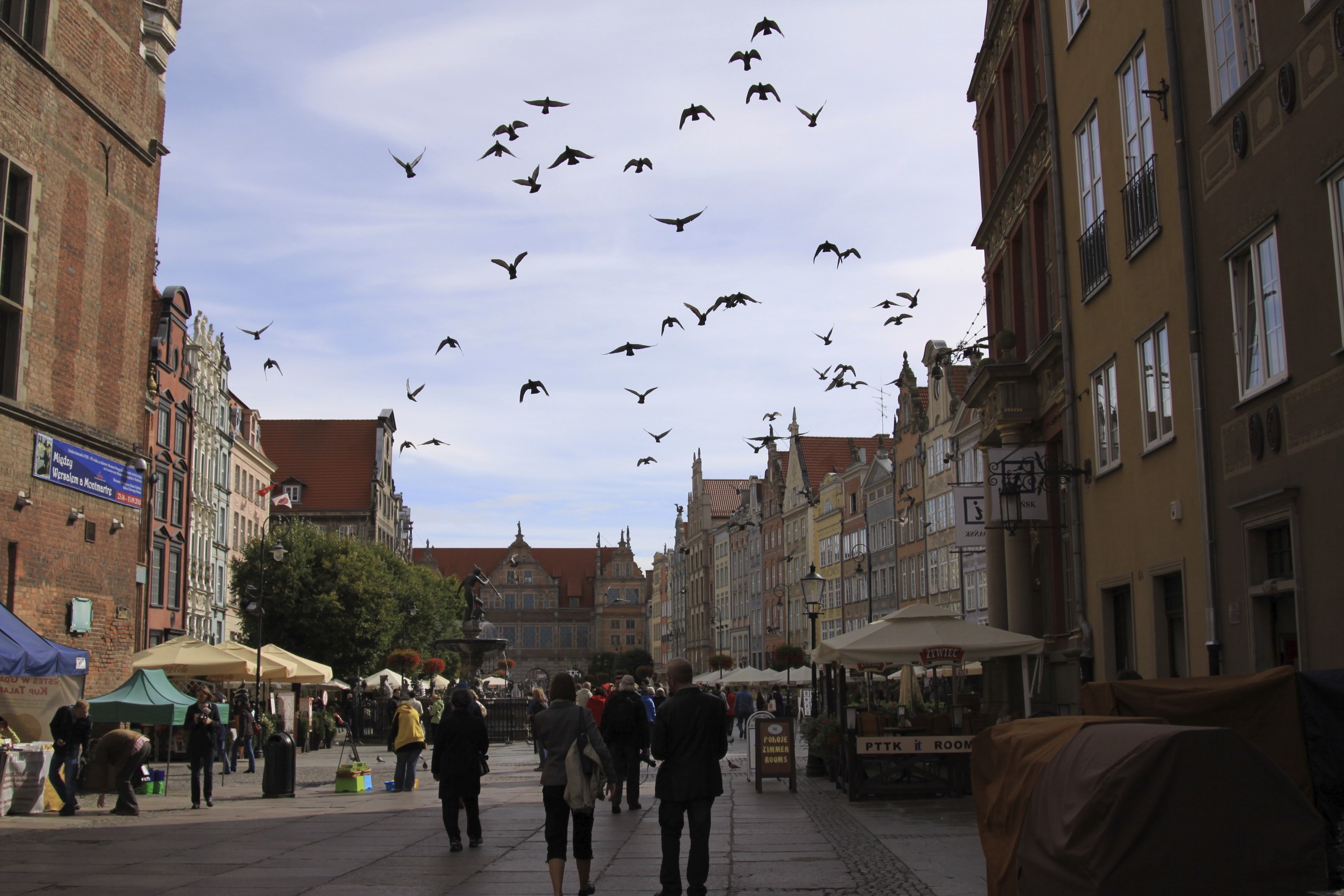
Old town Gdansk, Poland

Bornholm is an island in the Baltic that is actually closer to Sweden, and through the years has belonged to Denmark, Sweden, Germany and occupied by Russia. But the locals wanted to be part of Denmark and so they are today.

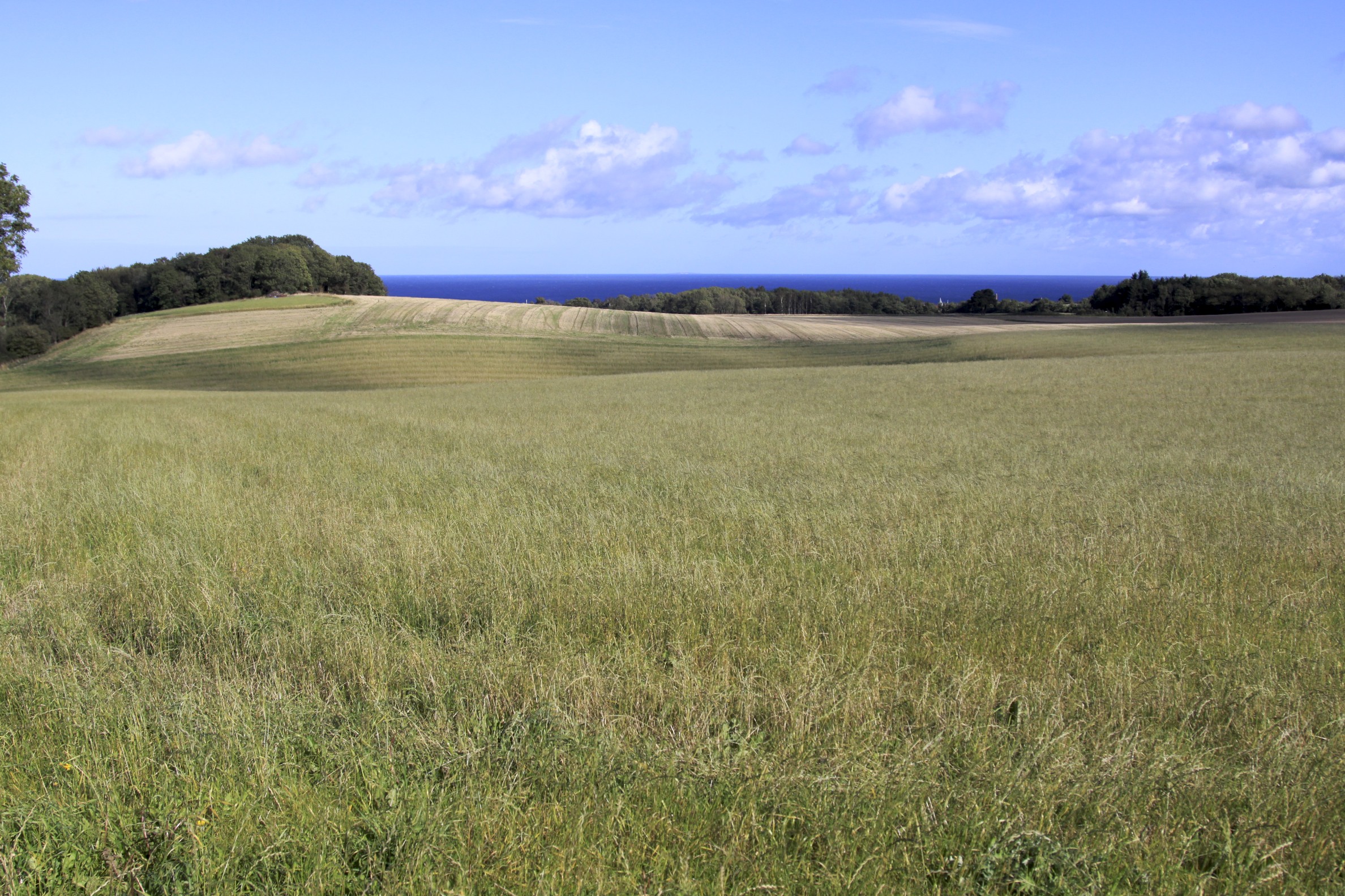
The countryside Bornholm, Denmark

We were thrilled to have a lovely sunny day, though it still rained on us a little at the beginning of our outing, but ended without a cloud in the sky. We were even able to hike back to our ship after visiting the ruins of a fortress.

I can’t remember if it’s the oldest or biggest ruined fortress in Europe, but it is surely one of the most striking (especially on a sunny day). Perched on a hill above the Baltic, the 13th century ruins were a photographer’s delight. Both Barnaby and I were reminded of the Falklands because of the wind — only the albatrosses were missing.

We had a very interesting visit to Gdansk, Poland yesterday. Lech Walesa is still inspirational — it’s not hard to see how he could unite people.

Tomorrow is our last full day on the ship — we can’t believe how fast the days are passing. Glad we have a couple days in Copenhagen before going back to New York.


Somewhere in the Baltic

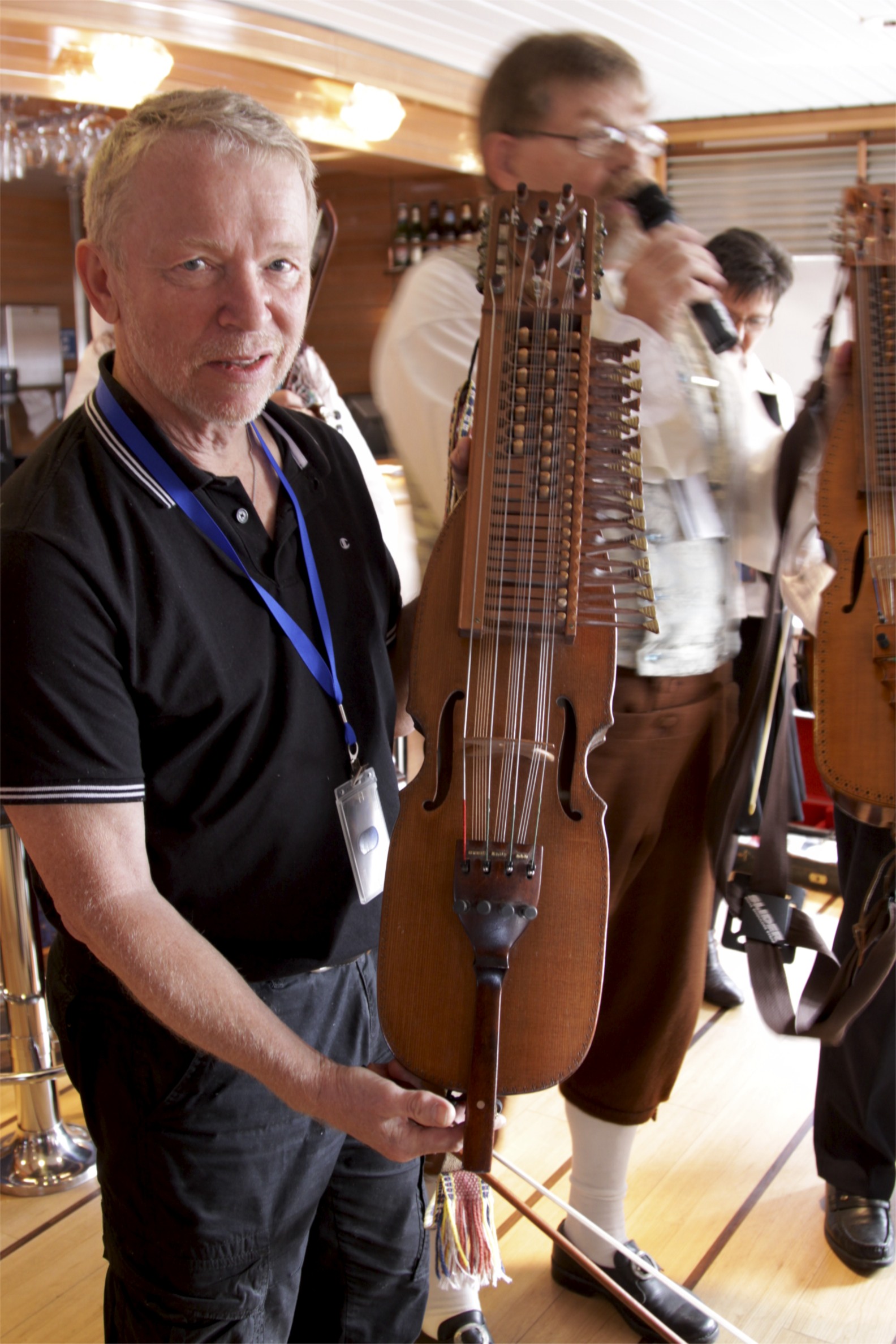
On Wednesday, we landed in Visby, on the large island of Gotland, Sweden. The Hanseatic League was at one time centered on Visby which enjoyed a huge boom in the 13th century. After roaming around the charming city a local folk group came on board our ship for a performance. The quintet included a keyed fiddle.

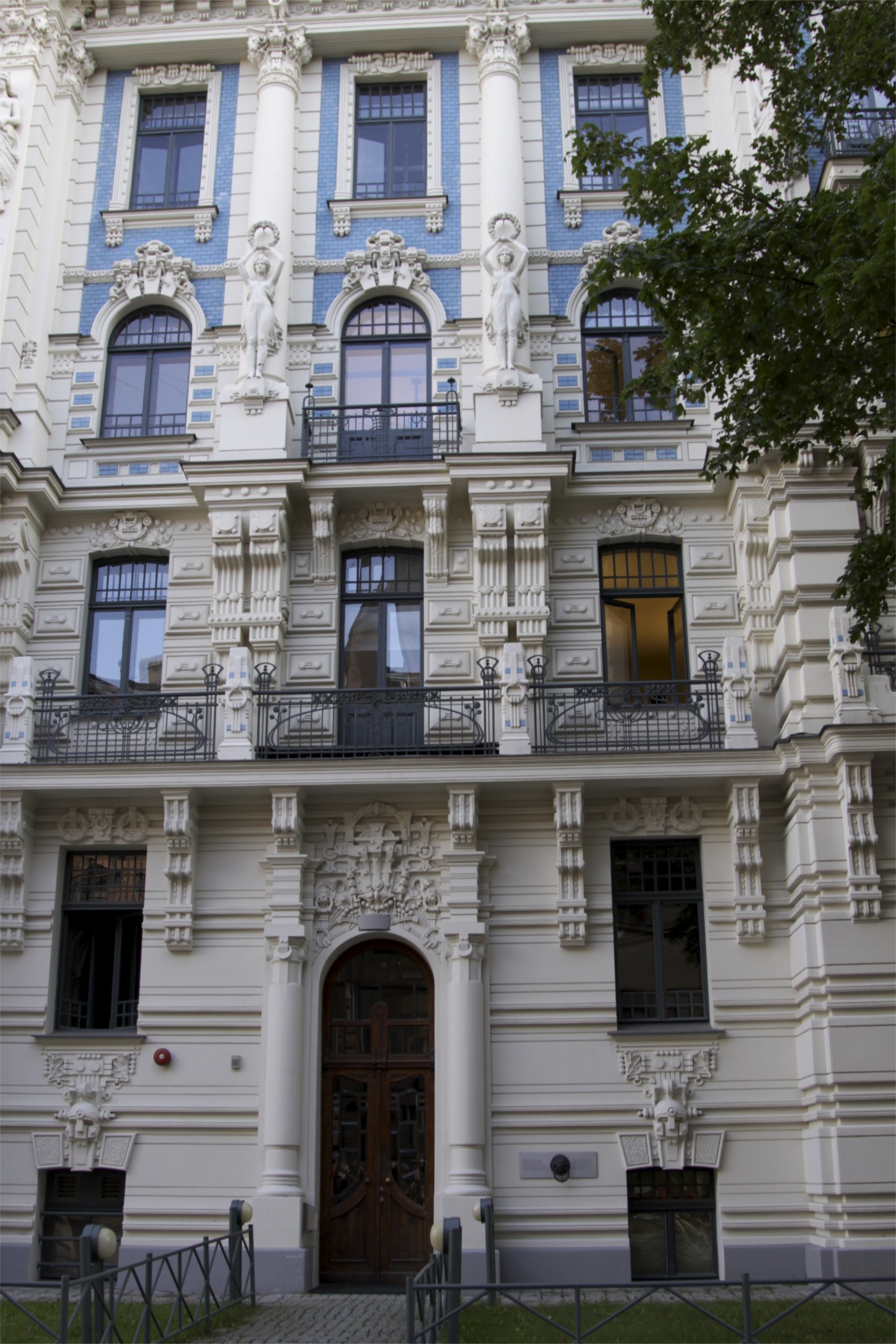
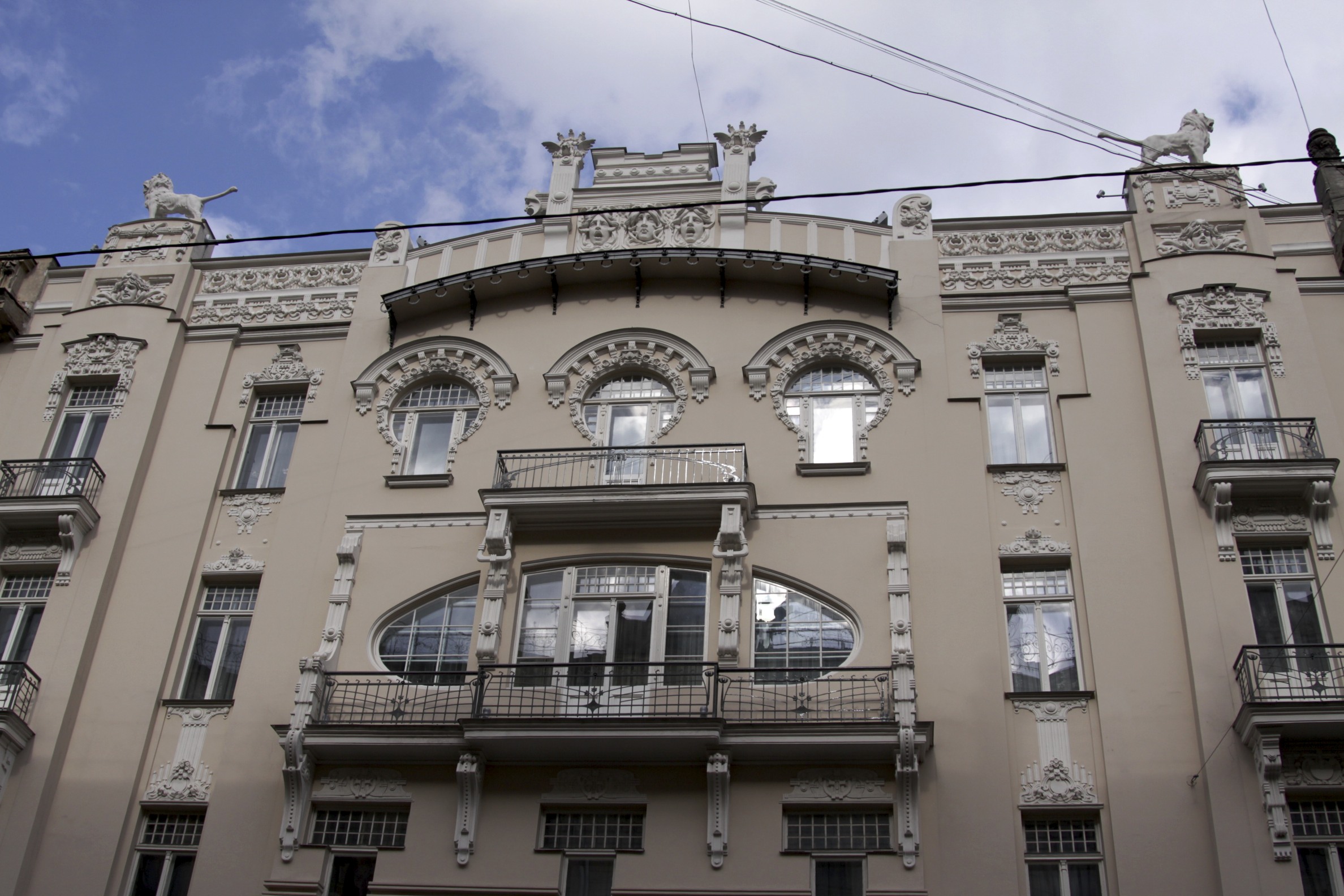
Yesterday, we spent the day in Riga, Latvia. I had no idea Riga would be such a beautiful city, as well as being famous for Art Nouveau architecture. The period from about 1900 to 1914 was glorious in Riga, some 800 Art Nouveau buildings have survived — more than anywhere in the world.

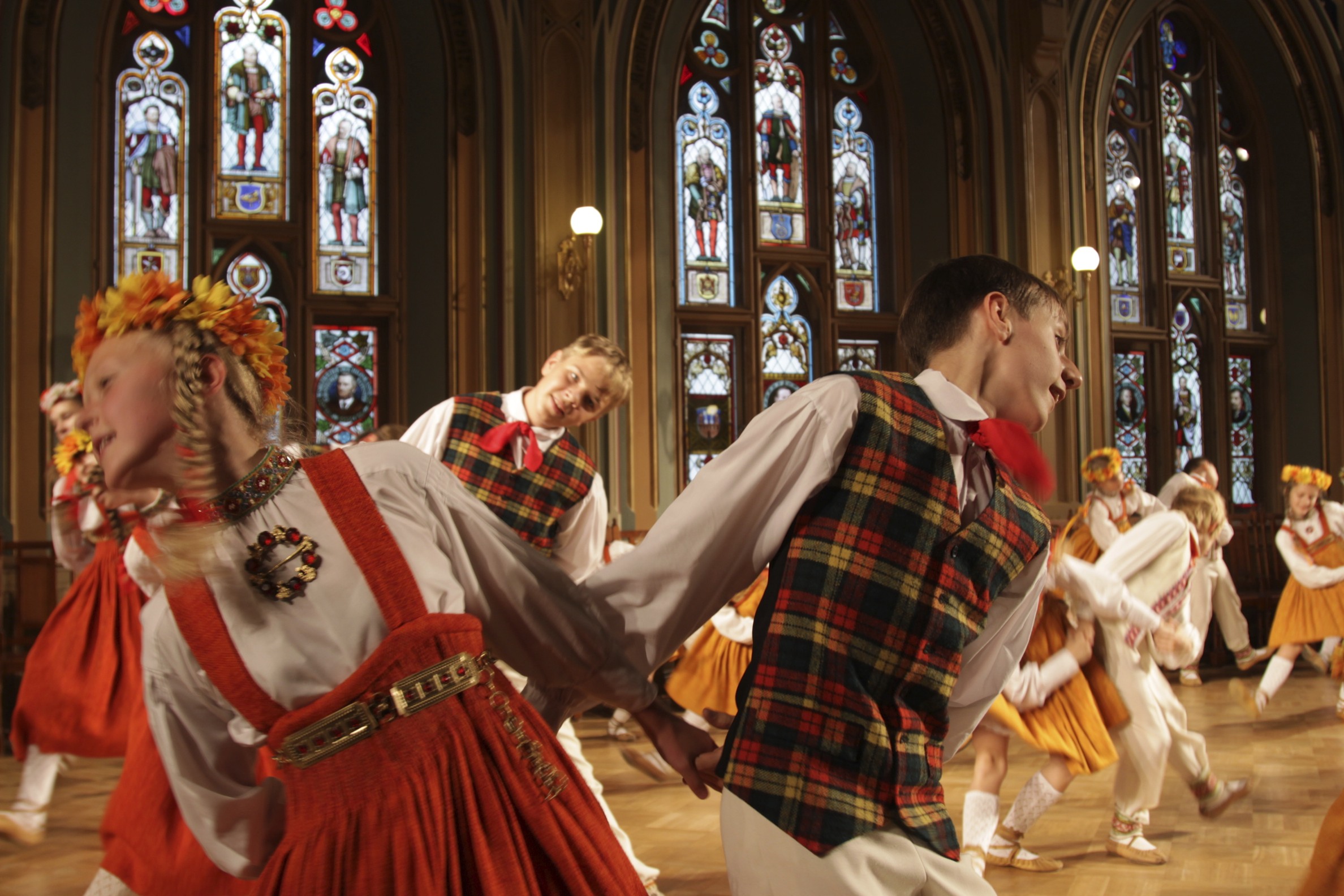
After a tour of the city, we attended a performance by a famous dance school. Girls and boys from about 8 to 15 performed Latvian folk dances. They were wonderful.

To top off the afternoon, we went to the oldest church in Riga and heard an organ performance on the largest pipe organ in Europe — 7,000 pipes. The concert started with Bach’s Toccata and Fugue in D Minor.

A few of us diehards went back out for a more in depth look at some of the Art Nouveau buildings, many of which are being lovingly restored. Many of those period buildings have not survived in other cities, having the Soviets in control in Riga had a small silver lining — the buildings may have been neglected but at least they weren’t torn down as they were all over Europe.

We’ve had a very rocky day at sea, everyone has been catching up on reading, sleeping and listening to some outstanding lectures. I sadly retain very little, though I could tell you about some fascinating shipwrecks in the Baltic. Did you know the Baltic isn’t very salty? They call it “brackish” because it’s not nearly as salty as the ocean. Why does this matter? Because ship worms don’t survive in fresh water, so the shipwreaks in the Baltic are in great shape. In the ocean a wooden ship would be eaten down to nothing in about 10 years — not here. But I’ll save that story for when we get home!

Tomorrow morning Lech Walesa is coming on board to give a talk. Hello Poland!


September 14, 2010

The Stockholm Archipelago: Uto

At about 7 this morning, we sailed out of Stockholm. It was a gorgeous sunny morning so I jumped out of bed, threw on some clothes and grabbed my camera. I wasn’t fast enough to see the old town of Stockholm, but I did get several photos of the coast and drank several cups of coffee in the process.

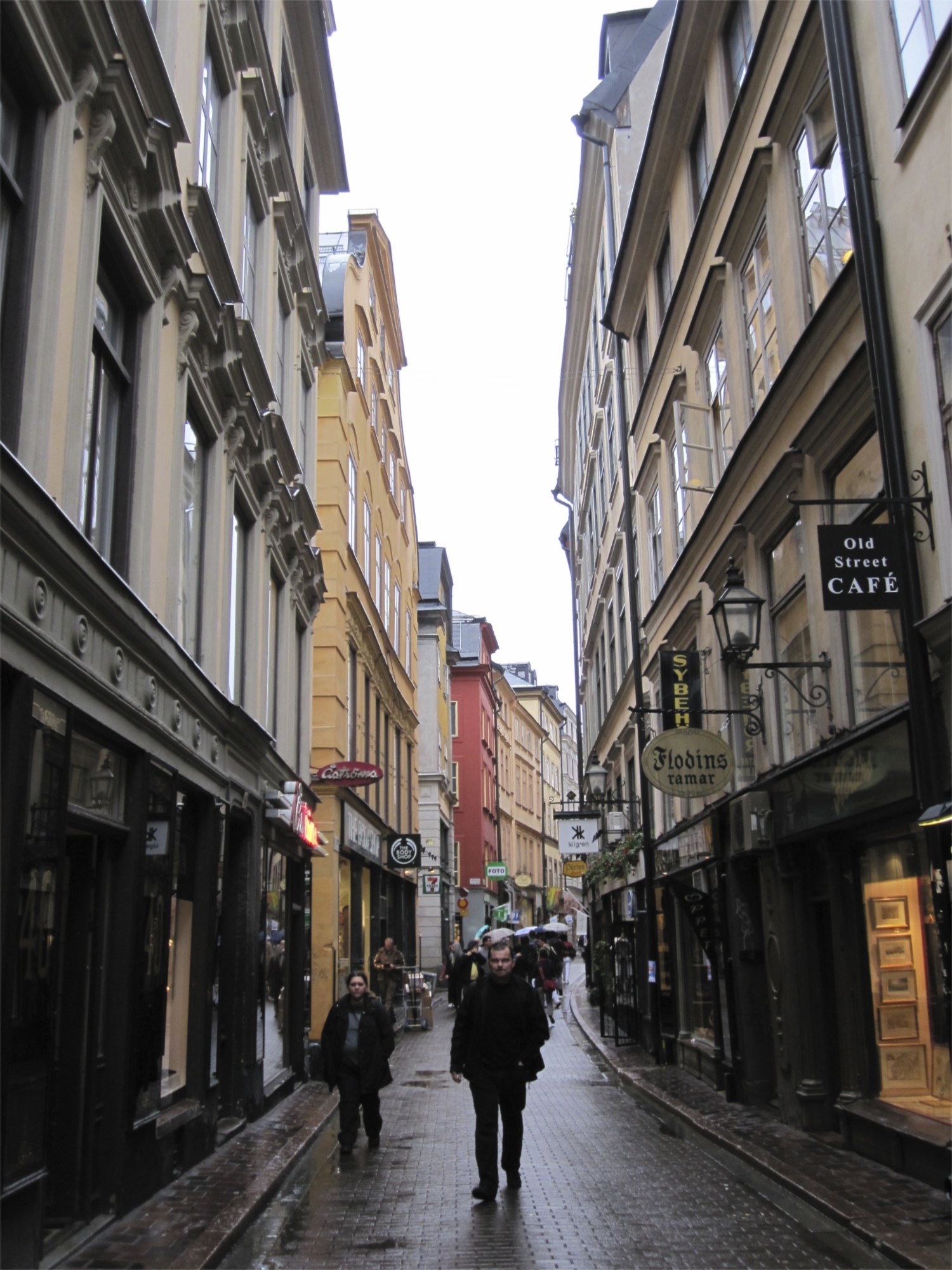
Old Town Stockholm

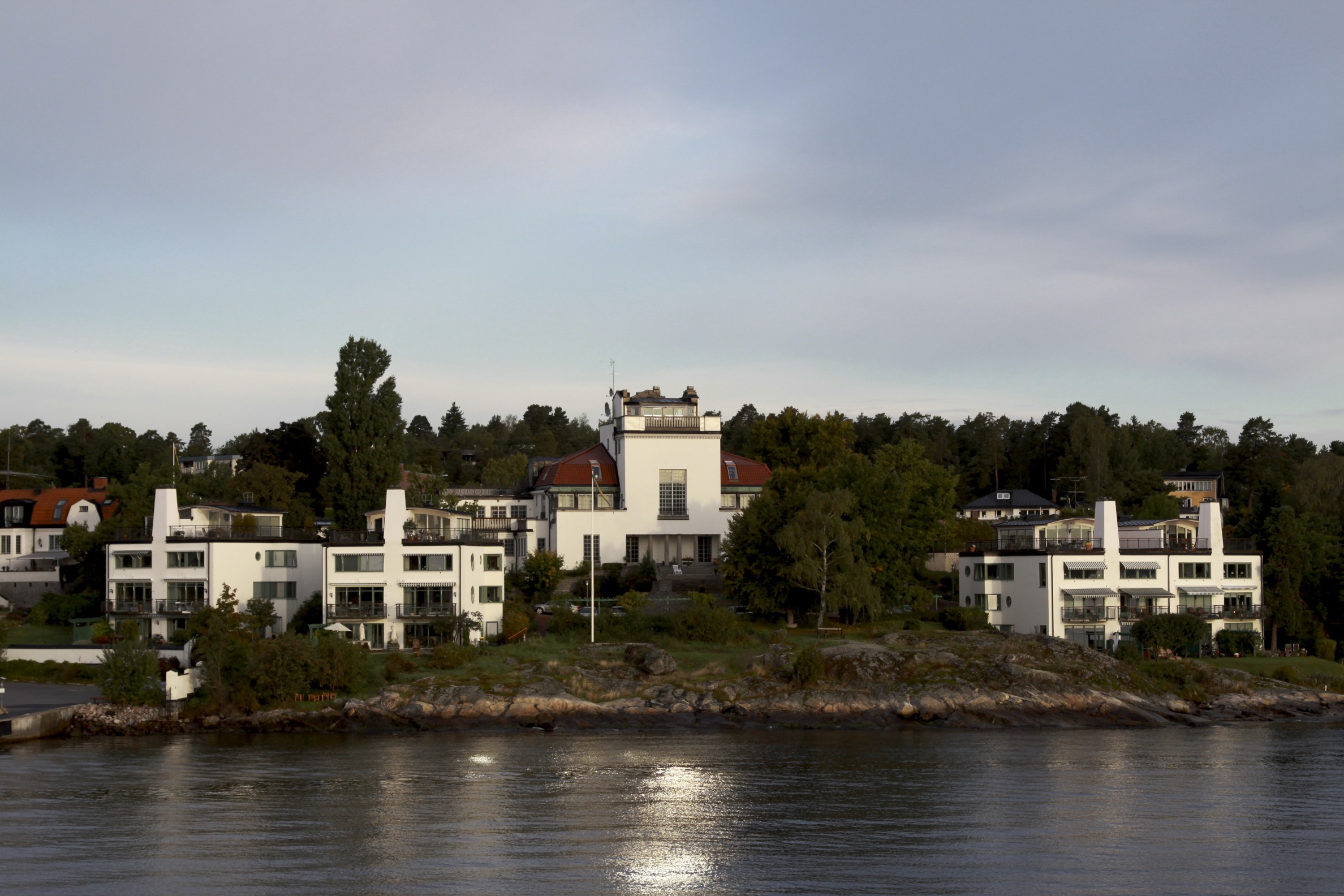
Summer homes on the Swedish Archipelago

There are more than 25,000 islands in this picturesque archipelago, this afternoon we stopped and visited one: Uto.

Uto rose from the sea about 10,000 years ago. The first inhabitants were probably nomadic fisherman and hunters. A permanent population between 550 – 1050 is documented in the graveyard. Iron was mined on Uto during the 1100s in one of the oldest mines in Sweden. Now it’s a resort for Stockholmers and the year round home for about 100 people. There’s a ferry to Stockholm that takes about 40 minutes, it took our ship about five hours but we were going at a leisurely pace, and in the winter the locals drive across the frozen sea when the ice is 8 inches thick.

Our Captain has the pedal to the metal at the moment — this is the first time our ship has rocked. We’re on our way to Gotland (doesn’t that sound like the sort of place Eric Northman on True Blood comes from?).

Speaking of Vikings — they were active in this area from about 900 to 1100, the first recorded Viking raid in Britain was in 793. After 1100 they generally mixed with the locals — so we all probably have a little Viking blood. They were so successful because their long ships were fast and efficient. They could travel from Scandinavia to Iceland in about two weeks, to Britain in one. Not bad for the tenth century.

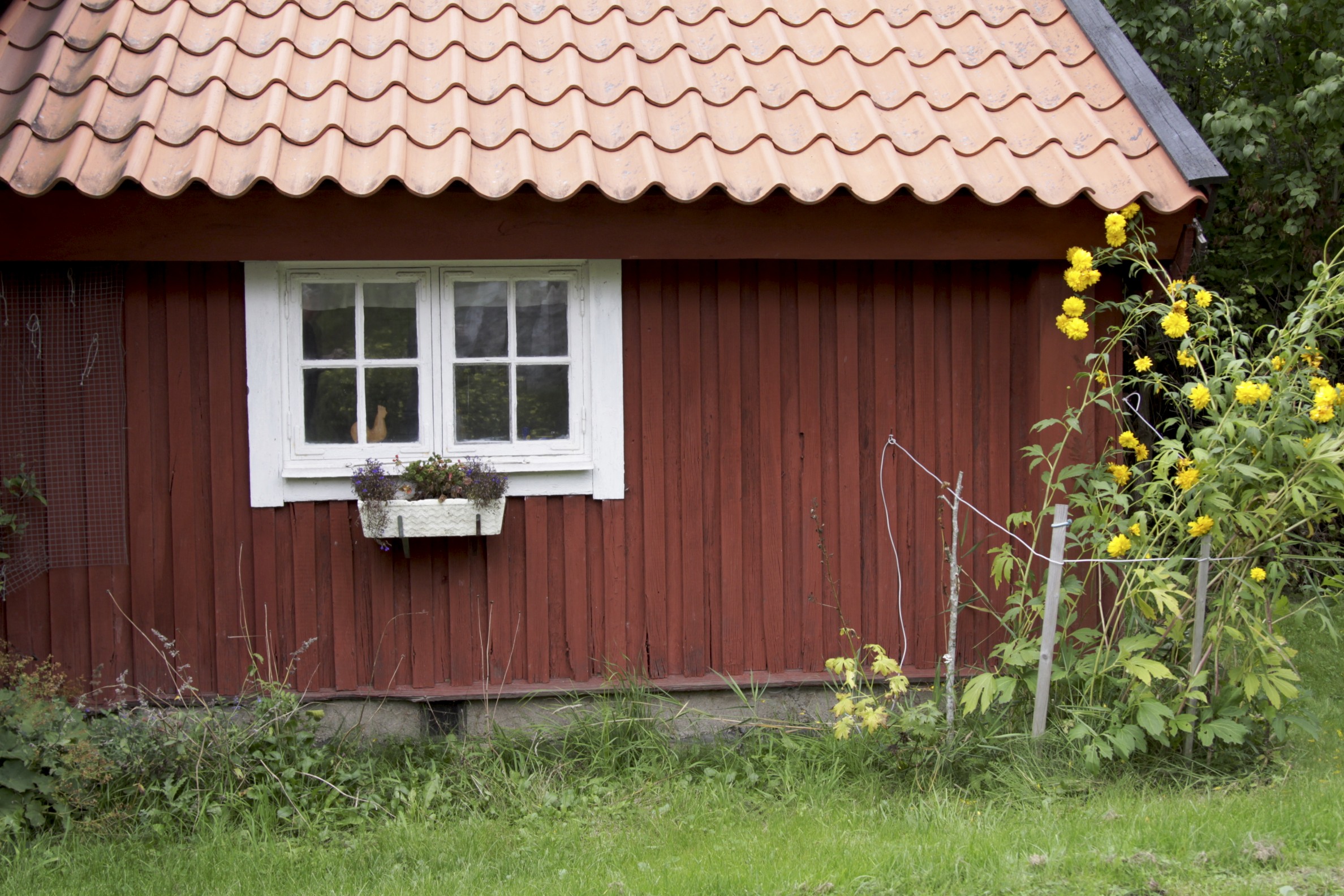
A summer cottage on Uto


Aland, September 12, 2010

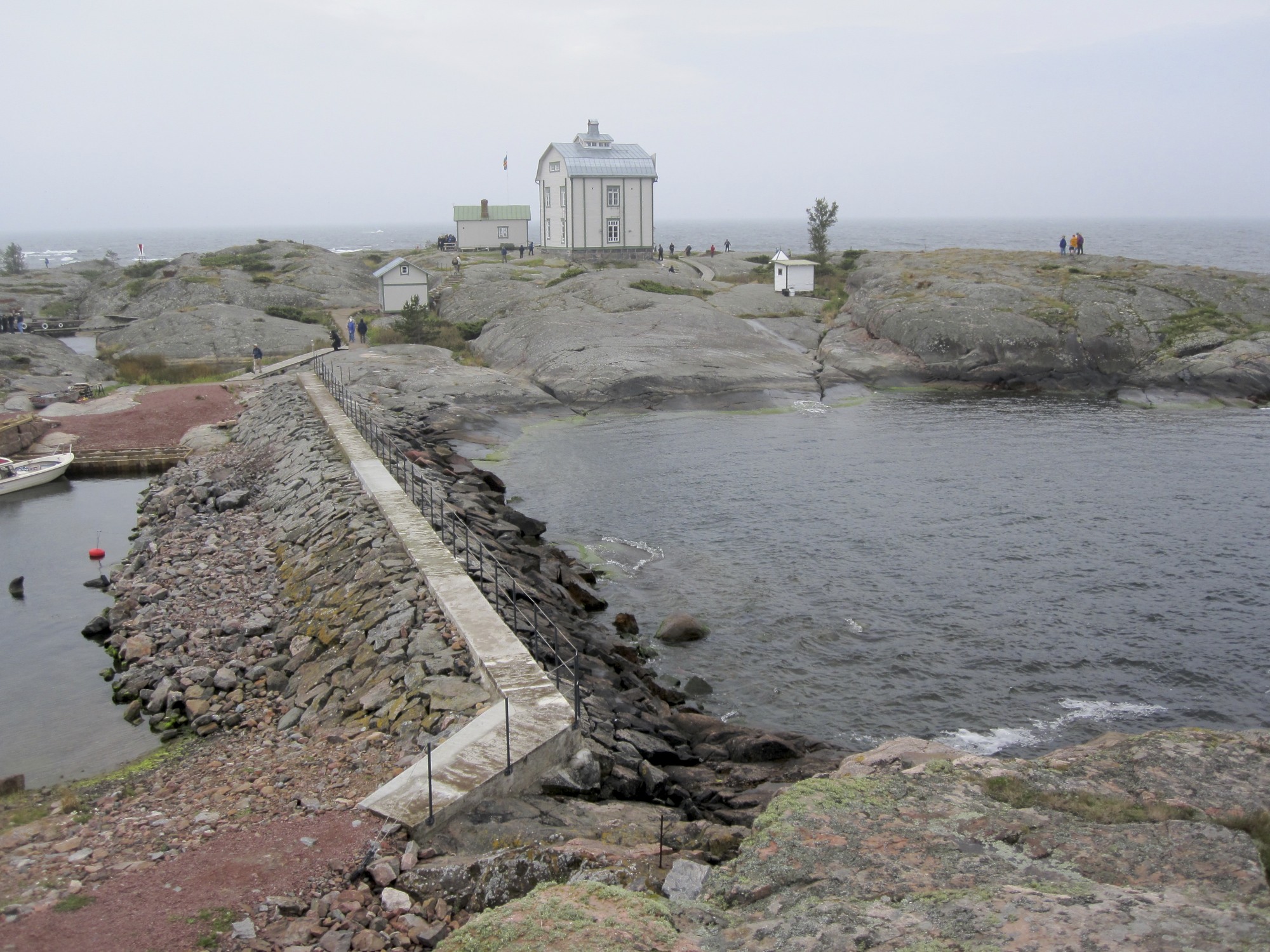
Aland, an island in the Baltic between Finland and Sweden, owned by Finland but Swedish is the language spoken.

This is a tiny island off the coast of Aland, the main feature is this lighthouse, or pilot house.

I’m sitting in the bar on our ship listening to Barnaby play the piano. A small crowd is starting to gather — there are several music lovers, and singers on board.

Speaking of singing, our visit to Estonia yesterday was amazing. What a tragic and lovely place. Estonia sits out in the Baltic and is bordered by Russia to the east and Latvia to the South, across the sea from Finland and Sweden. So it has had a long history of invaders and conquerers. In fact, it wasn’t until after WW1 that Estonia was independent, and sadly that only lasted for 20 years. Then Hilter made a pact with Russia in 1939 giving Russia control. It wasn’t until 1991 that Estonia regained their independence. They are truly amazing people though to have kept their language and if only in their hearts, their hope for freedom.

Currently only about 1 million Estonians live in a country about the size of Holland. Tens of thousands were executed by Stalin or sent off to Siberia by the Soviets. I mentioned singing because Estonians love to sing. They have a famous singing competition every five years and during that competition in 1989 the 30,000 participants ignored the Soviet rules and sang their national anthem. That act, and subsequent peaceful demonstrations, cemented their resolve to gain freedom from the Soviets.

After spending a few days in St. Petersberg and hearing our guides tell us how hard their lives were during the Soviet time, I am only reminded how lucky we are to be American. We have no idea how harsh life really is in most of the world. We certainly have never suffered in modern times, or today for that matter. Though Russia is a much freer and more prosperous place, but the divorce rate is currently 85% and the average life expectancy for men is only 60, women live another 12 years. The birth rate is among the lowest in the world, and there’s still problems with housing and health care. Our guide, who’s 40, says she’s happy for the fall of the Soviets, but her parents preferred that system since they actually had better health care and more job security. She remembers living in an apartment as a child where there were four families living together with one bathroom — imagine 15 people and one bathroom. She currently has a two bedroom, two bath apartment and her mother can’t help but say “Why do you need two bathrooms?!”. The shops are full, there are no lines, and there’s no food shortages like there were during our visit in 1986.

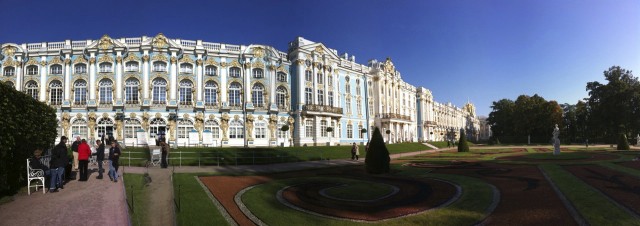
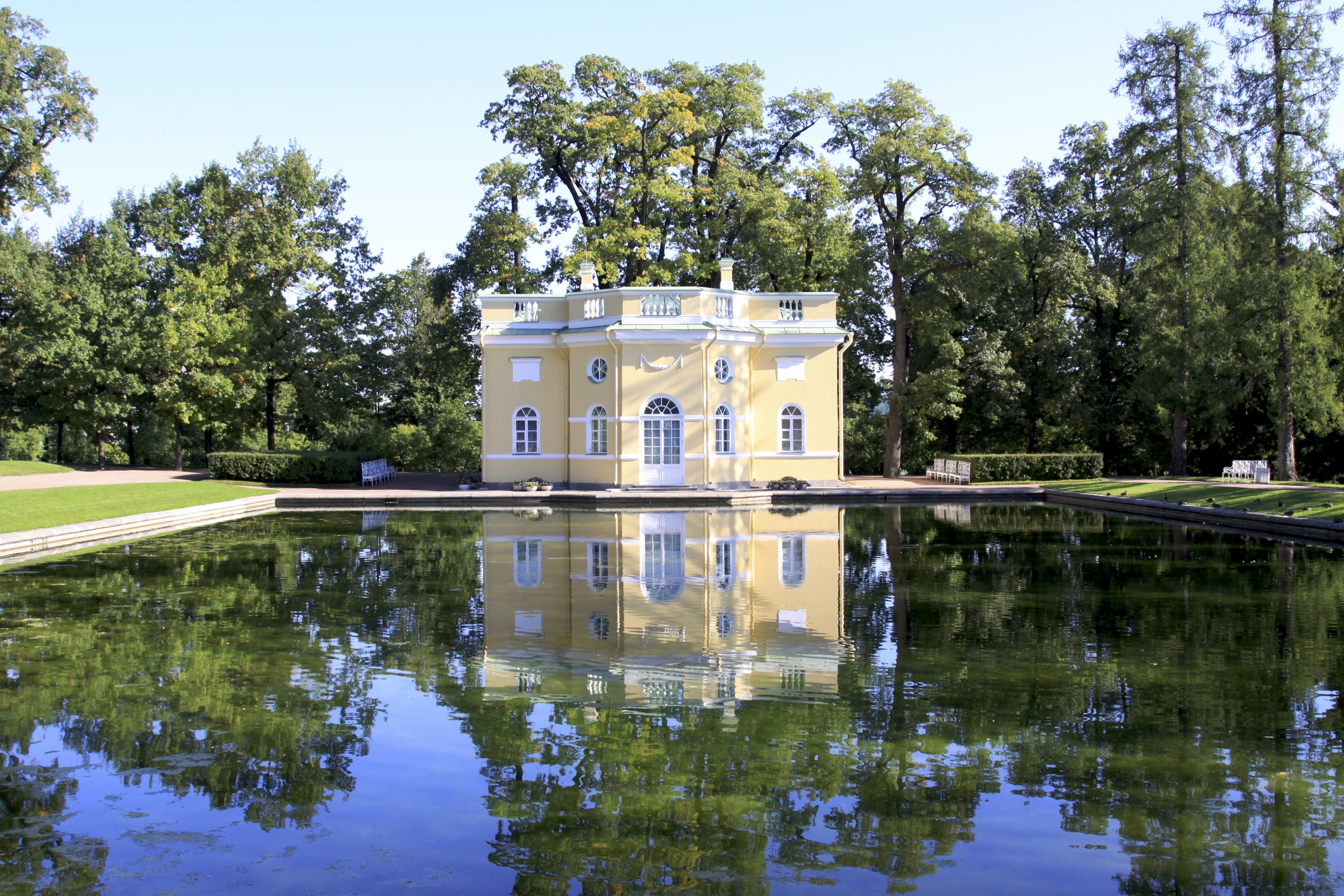
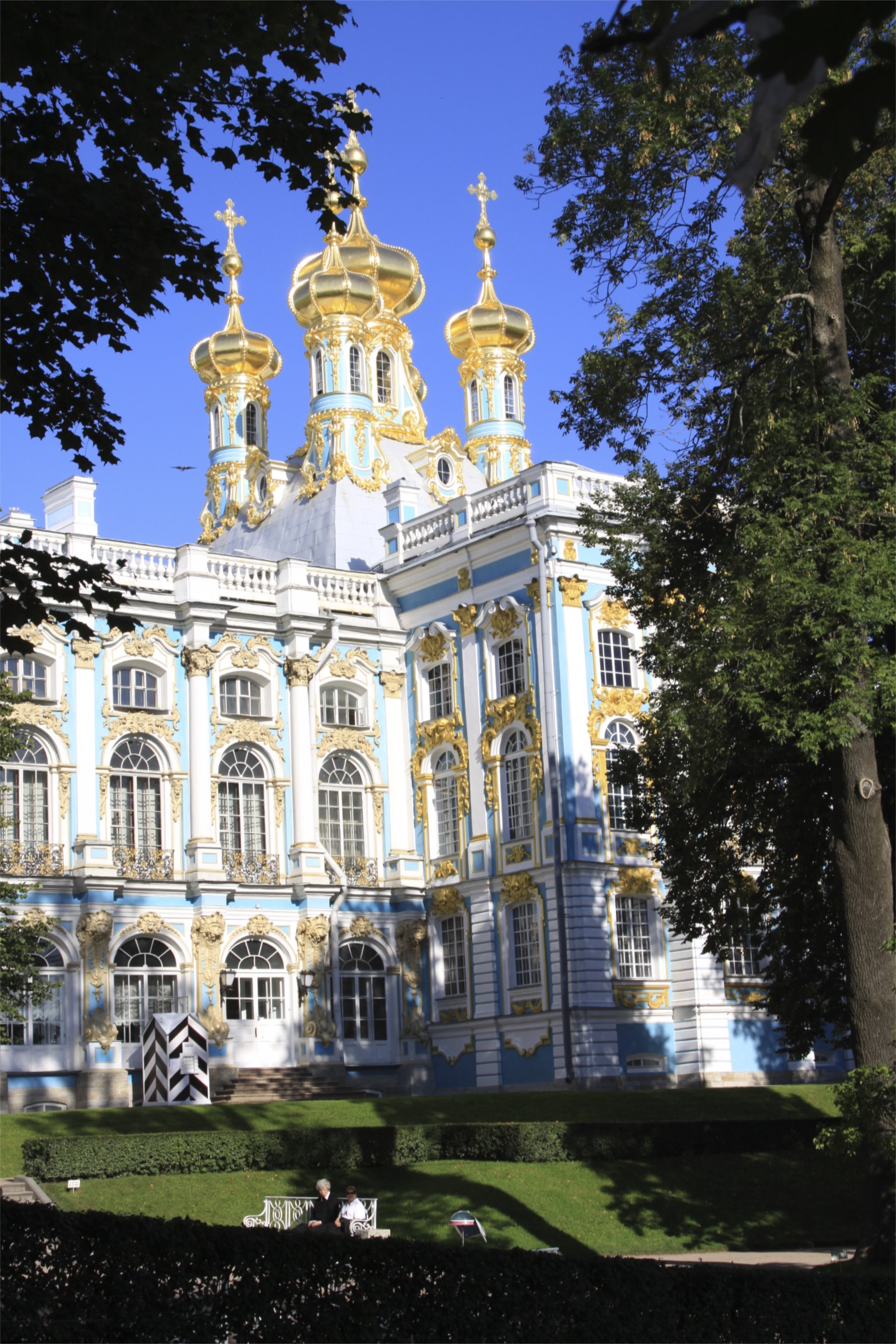
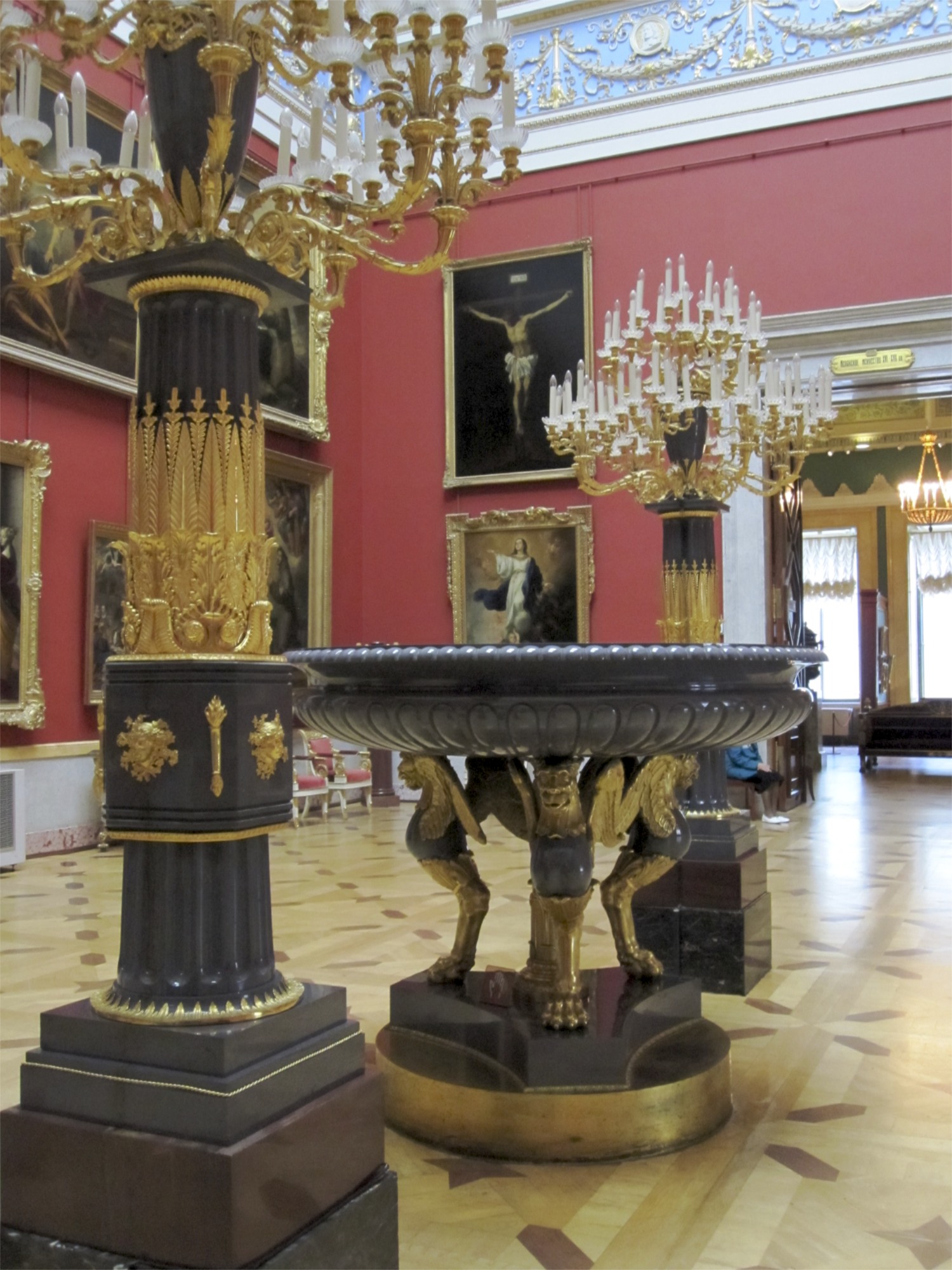
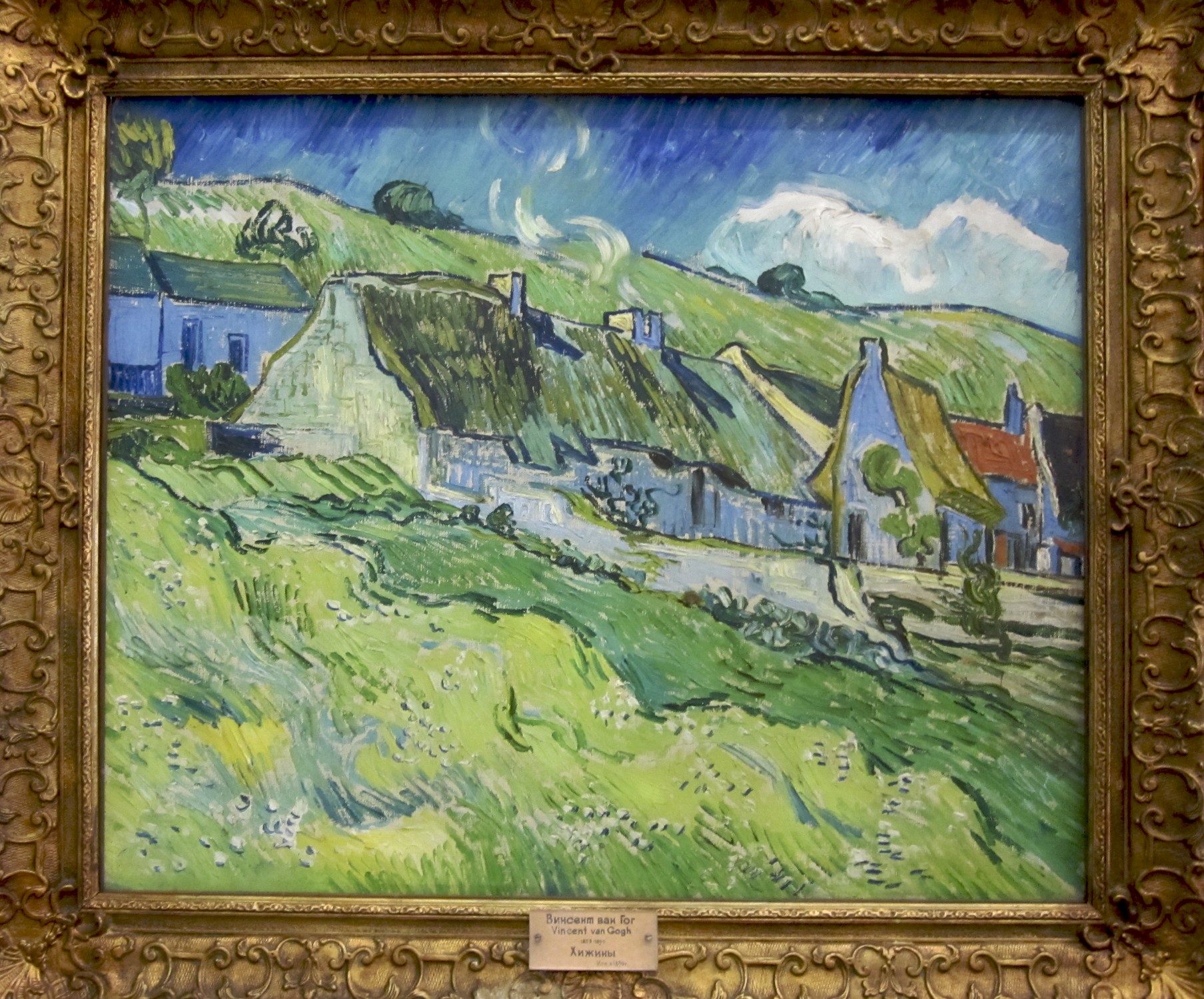
We visited Catherine’s Palace in Pushkin, the summer palace of Catherine the Great and the Czars of Russia. It was nearly destroyed in WW2 but they have meticulously restored it. We had a gorgeous sunny day, one of the 30 cloudless days that annually occur in St. Petersberg. The next day, our last in Russia, we spent in the Hermitage Museum. It was the winter palace of the Czars and is probably the most beautiful museum I have ever been in. We were very lucky to be traveling with this ship — our group was able to enter the palaces and the Hermitage about two hours before the regular opening times — so other than our 140 cruise mates — we had the space to ourselves.

A typical room in the Hermitage Museum

One of the many Van Goghs in the Hermitage


September 8, 2010 St. Petersberg, Russia

Just about to say goodnight to our first full day in Russia — it’s after midnight and since I’ve been awake since 4 am and on the go since 7 I’ll make this brief.

After our 1986 trip to the USSR — Moscow, Samarkand and Tashkent, I swore I would never come back — but I’m glad I changed my mind and agreed to visit St. Petersberg. So much has happened here in 24 years and it is a lovely city.

Here are a few photos — promise I’ll write more tomorrow.

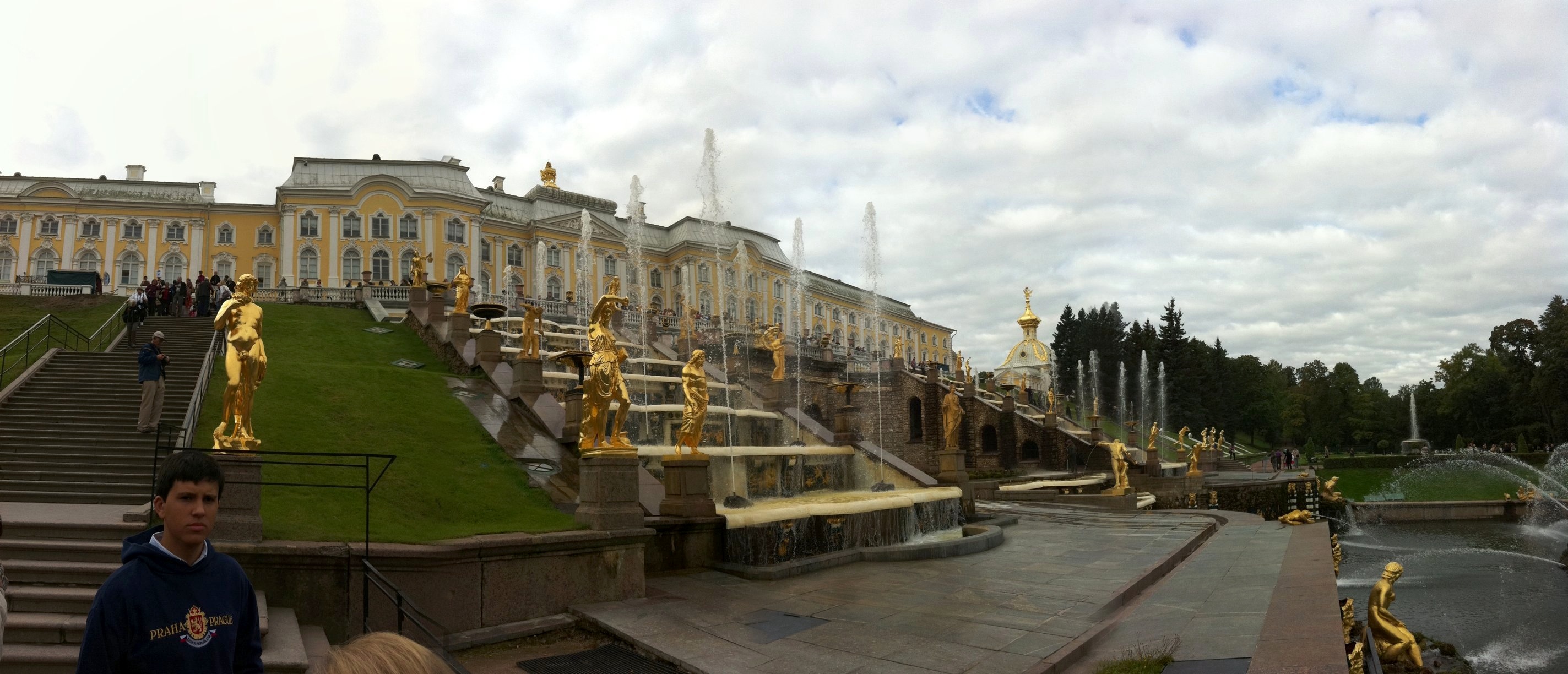
The weather was dry and warm but overcast — poor for photography. My iPhone makes the best of poor conditions. This is Peterhof Palace, about an hour outside of the city, Peter The Great’s country home built in 1704. Peter was fond of fountains — there are over 100. Peter built St. Petersberg (its third name — first St. Petersberg, but then changed to Petrograd after WWI since Peter is a German name and Russians aren’t fond of Germans, then to Leningrad, even though Lenin wasn’t from here, then back to St. Petersberg), so he would have an outpost on the Baltic, it sits on the Bay of Finland. Helsinki is only 300 km away. It was swampland that they filled in and created canals, it’s a lot like Venice only much larger. In fact, it’s the only city over one million (nearly five million actually) above 60 degrees north.

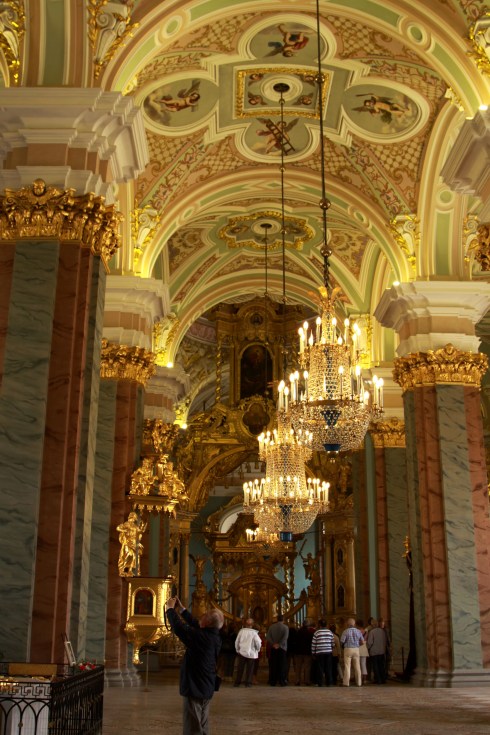
After a delicious lunch and extensive tour of Peterhof, we had a tour of St. Petersberg and a visit to the old fortress and the Peter and Paul Chapel. All the important Czars are buried there — including some very interesting women, among them Catherine The Great. She was married to Peter the Third, Peter The Great’s grandson, but her “Favorite” — Lord Orlov, took care of Peter (he preferred playing with his toy soldiers to matters of state) and Catherine ascended to the throne and ruled for 34 years. She built Orlov a gorgeous palace as a little thank you gift. Catherine liked to wear pants — there was a great portrait of her on horseback — astride of course.

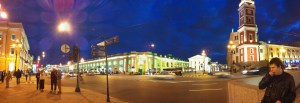
We walked back to our hotel after dinner — the streets are teeming with people shopping and out for dinner, nothing like Moscow of 1986.

Click on the photos to see them full size. Promise I’ll write more soon — there is so much to share.

Anne


From the archives: Greetings from the Falklands

March 11, 2008

Greetings from the South. We had an uneventful trip down to Ushuaia and got on the boat Saturday afternoon. Though we’re still jet lagging (these turkeys wake us up at the crack of 7 for breakfast — yikes!) we’ve certainly had plenty of time to catch up on sleep.

We’re in Port Stanley, the Falklands — arrived yesterday morning and spent the day visiting two islands off the western island and this morning arrived in Stanley (the largest city). This is actually our third visit to Stanley so we opted out of the tour and instead spent the afternoon walking around town. We had a Guinness at the Liberty Bar (thought we’d branch out — we usually go to the Globe) and decided not to have the fish and chips since they’re really not that good (the fish is most likely frozen fish fingers shipped in from Chile). It was 65 degrees, sunny and not even windy (not typical Falklands weather). We brought cold weather clothing but I doubt we’ll be wearing it unless the weather radically changes in South Georgia — which it easily could. It was raining the first night in Santiago, which was lovely since they’re at the end of a long summer and really needed the moisture. That part of Chile feels very much like Southern California — mountains, vineyards, dry and smoggy. Ushuaia was overcast but warm enough that we didn’t need a sweater. After South Georgia we’ll be in heading toward the equator so we’ll certainly be packing away all the fleece. 

Barn has played piano every evening — it’s not going to be a very demanding job. I think he’ll organize some singalongs (there are a couple John Prine fans  and singers aboard). The crew is delightful although we were very disappointed the “expedition leader” that we had last year had to leave suddenly because his dad is dying. The guy that replaced him is very nice and knowledgeable, but he doesn’t have the same enthusiasm and people skills. The ship isn’t full so we’re 1:1 passenger to crew. There are several people from National Geographic: the recently retired head of photography, a writer that’s been with them for 30+ years, his wife who also wrote for the magazine, a historian, and a couple more photographers and then all the naturalists. I’ll have to really try hard to not get a decent photo or two with this illustrious group (I may even learn to write a decent travelogue).
Our fellow passengers are an interesting bunch: the usual potpourri of retired doctors, lawyers and university professors (Barn and I are in the bottom rung of years of education in this lot), all liberal (thank goodness — couldn’t really stomach too many republicans at the moment) and all very well-traveled. It’s a different group than last year, more “peak-bagger” types that want to go to these out-of-way places more to check them off a list than having had a lifelong desire to see, for instance, Shackleton’s South Georgia.  There are several birders — who are always unique. Another difference is there are a couple of young people along (young being in their 20s). The hiking contingent seems somewhat smaller too. We did two walks yesterday that literally wiped out most of the group (Barn and I didn’t break a sweat — what does that tell you???).

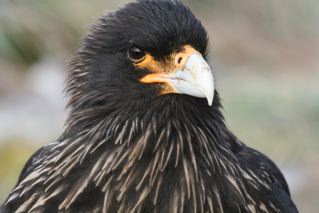
This is a striated kara kara, one of perhaps 1,000 breeding pairs in the world, 99% live here in the Falklands. They’re huge, curious, mischievous and I think very beautiful. The locals call them “Johnny Rook” and think of them as pests (what do they know!!).

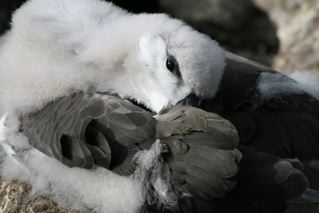
This is a three-month old black browed albatross fledging. After shedding the downy feathers in about three more weeks, he will take to the skies for perhaps 3 to 4 years before coming back to this colony to breed. They are completely waterproof and will rest on the ocean even if they don’t come back to land.
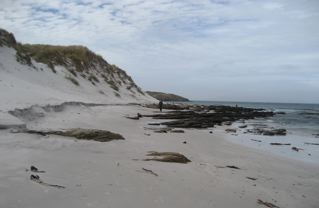
A beach in the Falklands. Who knew they have gorgeous white sand beaches.
We’re pulling out of the harbor now on our way to South Georgia. We hope for calm seas.

From the archives: St. Helena & The Big Blue Sea

March 30, 2008

“Nowhere else than upon the sea do the days, weeks and months fall quicker into the past. They seem to be left astern as easily as the light air-bubbles in the swirls of the ship’s wake.”  Joseph Conrad

The days are flying by along with the fish — yes, in these brilliant blue waters, much warmer than in the south, there is actually very little life. One of the few fish in these waters are flying fish. They’re small, only getting to a length of about 6 inches, so they are frequently eaten. There defense is to literally fly out of the water, spreading their wings (yes, they have wings) and using their stiff tails as rudders, they skip along the water in a zigzag for up to fifty feet.

On Friday, we spent the day in St. Helena, an island probably most famous for being the final place of Napoleon’s (Groiny Boney) exile. Since we’re in the tropics and closing in on the equator soon, the temperatures are much warmer, even the air conditioning on the ship has struggled with the high humidity. (At this point, I’m never sure if it’s really hot or if I’m just having a constant hot flash.) Hundreds of miles from any other inhabited islands and over a thousand miles from Africa, St. Helena’s population (the Saints) long for an airport, tourists, more jobs — sounds like Idyllwild doesn’t it? It’s fascinating visiting these islands and talking to the locals — St. Helena is so different from Tristan, and sadly doesn’t have the wealth of fish like the Falklands. In the 17th century, when sailing ships were going around to India and China from Europe, St. Helena was an important stopover for resupplying in the tropics (there’s not much wind so ships would really slow down). The population has declined steadily since but Saints are still very friendly and we were giving a royal welcome.
Our next stop will be Ascension Island and we have a packed day planned. They predict the weather to be hot and dry and since these will be the first sandy beaches (with warm weather) on this trip, several are planning on spending the afternoon at the beach. We’re going back to the beach after dinner in hopes to see Green Sea Turtles laying eggs. These turtles make an amazing migration from the coast of Brazil to Ascension Island  to lay their eggs — a four-month journey covering about 1,500 miles with nothing to eat — then they go back and spend the next several years off the coast of Brazil before doing it all over again. If we’re really lucky we’ll get to see baby turtles erupt from the sand and make their way into the ocean to start their first trip to Brazil. Scientists don’t really understand the behavior — all they know is there is nothing to eat in these waters and the opposite is the case for coastal Brazil — it happens to be one of the few places in the world where the sea is incredibly rich — much like off the coast of California (50% of the world’s fish live in .1% of the ocean). Oh yeah, we sit through hours of lectures every day hoping to retain a little.

From the archives: Entering The Potato Latitudes

March 24, 2008

I spent the afternoon in the lounge trying to write, but got so much attention from my shipmates that I wasn’t able to complete a sentence. Even though this is a very sophisticated group, they’re curious and want to look at my cute computer. Than one thing leads to another — especially since I have this love/hate thing with Apple Computers (and I’m a born salesman). This is what it decays into:

Jennifer is a retired staff writer for National Geographic and delightful traveling companion. (This photo is before we discovered Mai Tais  were the drink of the day. And no, I didn’t have that many.) The Potato Latitudes are when you’re on a long trip in the middle of a huge ocean and there are no resupply opportunities. Today at lunch we had potatoes made three ways, we had other things, but make no mistake — we are in the Potato Latitudes!
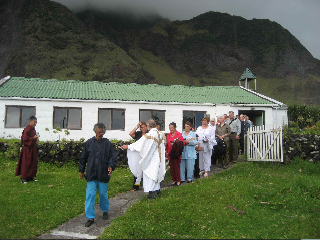
Yesterday morning I got up at dawn to attend Easter Sunday services at the Anglican church in Tristan da Cunha. I figured the opportunity would probably never arise again in my life.  The Tristanians were all so respectful — never yawning or sweating (the air was very warm and still), always seeming to know where we were supposed to be in the Hymnal, what to repeat, how many Amens to say.  Church services are a very interesting study of how to keep people involved (and awake). We were constantly having to stand for some reason or another making dozing impossible. Then there’s the singing — and this crowd loved to sing and sing loud. We didn’t have proper hymnals with words and music — these had just the words and tiny ones at that. I could barely read them without my glasses (what was I thinking?? I wouldn’t have to read at a church service??)  My biggest decision was whether or not to take communion. After wrestling with it for several minutes (I had time to think since I was in the back of the room) I went ahead — thinking I would stick out even more not going and thinking what harm would it do? No point to refuse a blessing — especially when it’s given with so much sincerity.  Barnaby stayed in bed, but joined me on the island with the later group. The ocean swells got so bad, we were barely able to get back on the ship and all felt lucky to have been able to go ashore at all.
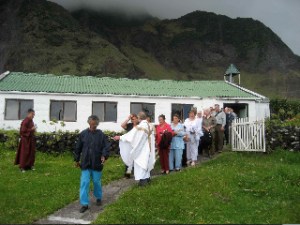
Tristan da Cunha has to be one of the most unusual places we’ve ever visited. Picture an island, 7,000 feet at the top of a volcano, about 1,500 miles west of Cape Town, South Africa and 1,200 miles south of St. Helena (the island where Napoleon was exiled and died) in the middle of the South Atlantic. We’d been sailing from South Georgia for 4 solid days to get there. There were no indigenous people and was only settled in the mid 1800s by a Scotsman. There are only 7 surnames and yet the 271 people who live in Tristan are pretty varied genetically because of the original settlers: a Scot, American, English, Dutch, Portuguese and two shipwrecked Italians that decided to stay. There is no airport, no safe anchorage (only 1 day in 5 can you safely launch a boat), no crime, and no divorce (though I suppose if you were really unhappy you’d just leave). Until 1945, they had no money and used potatoes for all their trading. Then, in 1960, the volcano erupted and all of the residents were evacuated to England. After 18 months, they plead to come back, bringing the Beatles music and a small taste of modern society. But they were still ready to give up the comforts to get back to their lovely Eden. I imagine it is very hard work living there: they fish, raise potatoes and other vegetables, have sheep, cattle, chickens, pigs and love to eat the occasional penguin egg. But much like Idyllwild, it’s a small town, everyone knows everyone else’s business, and yet everyone sticks together. Another interesting phenomenon is there’s an equality (no real estate moguls like Pete and Vic), everyone has a place — a purpose. Our little town is kind of like that too — we all accept Tuxedo Tim and Warren the Car Washer, they may be a little off level — but they still have a place in the community. It’s a fascinating anthropological study and I’ll be curious, now they have internet and satellite TV, to see what it’s like in another 10 or 20 years. It’s very appealing though I think you would probably have to have grown up there to fit in.
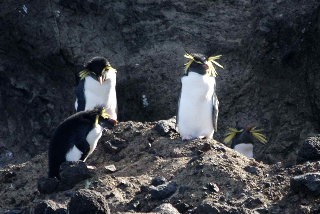
For our last penguin shot of the trip — we have the Tristan Rockhopper which is probably the most outrageous of all. Sadly, we were not able to land on Nightingale Island (there are three islands in the Tristan group: Tristan, Nightingale and Inaccessible) to visit the colony so I had to take photos from the Zodiac. They have red eyes, pink feet and the bright yellow feathers on their heads, and since the Tristanians like to steal their eggs — are probably not very friendly to humans.
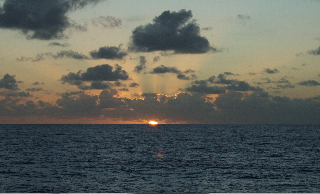
Now that we’re approaching the Tropics, all the polar fleece and long johns are packed away. We had a barbecue dinner on the deck tonight. Everyone saw the green flash at sunset. Our next stop is St. Helena — another extremely isolated island but nothing like Tristan.

From the archives: High Seas! March 18, 2008

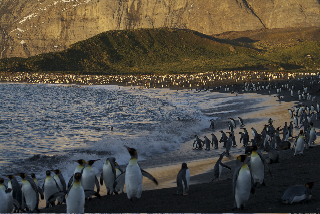
We’ve left South Georgia and our now on our way to Tristan de Cunha, an island that’s almost as isolated as South Georgia. Our last two days in South Georgia were incredible. I know I’ve sent a lot of penguin photos but I can’t help myself. Yesterday we got up at 5:30 am to watch the sunrise over a beach that is surrounded by mountains and glaciers. (Okay there’s no bad scenery in S.G.) Molting elephant seals are fond of this particular beach — they’re fascinating to watch even though they’ll mostly sleeping. When one does make a move it upsets the whole mound and frequently ends up in a short-lived battle where they rise up, mouths gaping and growling, and knock each other until they grow tired and settle back down into the pile. During the breeding season the battles aren’t short-lived and are often to the death. I’m glad we don’t have to see that. The males are enormous, the females a tenth of their size. I don’t know how those little girls don’t get crushed by those beasts.

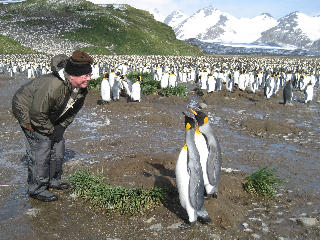
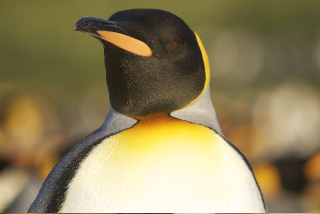
Then there are the penguins. You can’t tell a male from a female — even the experts can’t unless they see them breed. They share in all of the responsibilities equally: egg-sitting and food gathering. They mate for life and they seem to be very affectionate (I know I’m probably being silly but wait until you see my photos and how they preen each other and cuddle). If penguins seem awkward  on land, though they have no trouble climbing steep cliffs to their nests, they are truly “sea birds” and are elegant ballerinas in the water.

South Georgia is home to more breeding pairs of wandering albatross than anywhere in the world, giant petrels abound, actually several varieties of birds like petrels, shags, sheathbills, prions, and skuas, but nothing is more fun to watch than the penguins. Since they have no land predators, they have no fear of people so they pose happily even if you take 200 photographs in two hours like me.

Barnaby played the organ in the little church in Grytviken delighting our fellow passengers.  Grytviken is the center of what little government there is in South Georgia (and where Ernest Shackleton is buried). In its day, it was a prosperous whaling station, happily closed down since 1966 (the whales have not made a comeback). Since our ship isn’t full and is the last tourist ship to visit this season, we invited all of the government employees (all 19) on board for dinner and cocktails. I was so surprised when a very young (and good-looking) group arrived. I don’t know why I thought they would be crusty old men, I couldn’t have been more wrong. The “boatman”, an adorable young man from Guernsey, joined our table and very politely answered all of our questions — even the personal ones Americans are so fond of asking.

Yesterday afternoon we sailed up a gorgeous fjord — our last stop in South Georgia. Now we’re in the open ocean and anyone that may suffer from seasickness has retreated to their cabin. It seems like a pretty hardy group as there weren’t many empty seats at dinner. The captain changed course a few hours ago to veer away from the storm because we weren’t making much progress headed into such strong winds. We had a lecture this afternoon on wind, the Beaufort Scale, and waves. We’re in a gale: “moderately high and long waves. Crests break into spin drift, blowing foam in well-marked streaks.” That translates to about 42 mph winds. It’s about 40 degrees and raining. The captain promises better weather tomorrow. We all walk like we’ve had far too much wine with dinner.

We sure miss everyone. Wish you were here with us…….